What is the 50/30/20 Budgeting Rule? A Simple Beginner’s Guide
Managing money often feels overly complicated. Between tracking every single coffee purchase and staring at complex spreadsheets, traditional budgeting can quickly lead to burn-out. If you have ever abandoned a budget after two weeks, you aren’t alone. Interestingly, you aren’t doing it wrong. You might just be using a system that is too rigid for your lifestyle.
Enter the 50/30/20 budgeting rule. Popularized by Senator Elizabeth Warren in her book “All Your Worth: The Ultimate Lifetime Money Plan”, this simple framework eliminates the micro-management of traditional budgeting. Instead of tracking dozens of individual categories, it divides your money into three straightforward buckets: Needs, Wants, and Savings.
If you are looking for an easy, sustainable way to take control of your cash flow, here is your complete beginner’s guide to mastering the 50/30/20 rule.
The Golden Rule: It All Starts with Net Income
Before dividing a single dollar into budget categories, you must start with the correct baseline number. Your Net Income (take-home pay), not your Gross Income.
Gross Income is the total amount of money you earn before taxes, health insurance premiums, 401(k) contributions, or other payroll deductions are taken out. Net Income is the actual amount that lands in your bank account on payday.
How to Calculate Your Net Income for Budgeting
To find your monthly net income, check your pay stubs or bank deposit statements. If you receive a regular paycheck, simply take your net deposit amount and multiply it by the number of paychecks you receive per month. Make sure biweekly paychecks are multiplied by 26, then divided by 12.
Important Note on Retirement Deductions: If you already contribute to a traditional 401(k) or health savings account (HSA) directly through payroll deductions. Those pre-tax deductions count toward your “Savings” or “Needs” categories, which we will adjust later.
The 50/30/20 Budget Breakdown
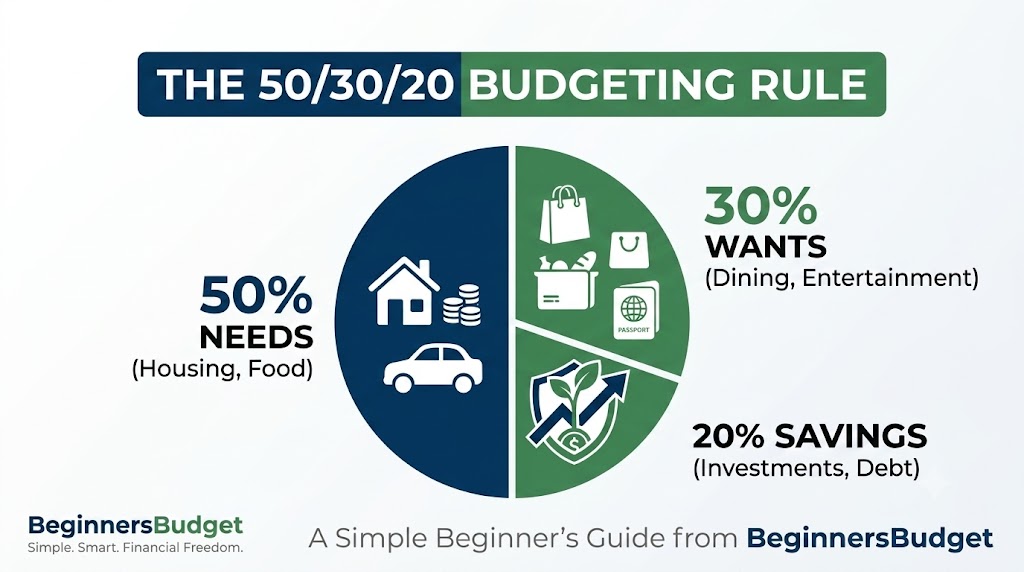
Once you know your monthly take-home pay, you divide it into three distinct percentages: 50% for Needs, 30% for Wants, and 20% for Savings and Debt Repayment.
Category 1: 50% of Your Income for “Needs”
Your Needs are non-negotiable obligations. These are expenses you must pay to survive and maintain basic employment. If you were to lose your job tomorrow, these are the essential bills you would still have to pay.
What counts as a Need?
Housing: Rent, mortgage payments, property taxes, and HOA fees.
Basic Utilities: Electricity, water, gas, internet (necessary for work/life), and basic mobile phone service.
Transportation: Car payments, auto insurance, gas, or public transit passes required to get to work.
Essential Groceries: Basic food items needed to cook healthy meals at home (excluding dining out).
Healthcare: Insurance premiums, co-pays, and mandatory prescription medications.
Minimum Debt Payments: The absolute minimum payment required to keep credit cards, student loans, or personal loans in good standing.
If your essential expenses currently swallow up more than 50% of your take-home pay, don’t panic. High-cost-of-living areas make this common. You can adjust the framework (e.g., 60/20/20) while working on lowering fixed costs over time.
Category 2: 30% of Your Income for “Wants”
The Wants category is where the 50/30/20 framework shines. Unlike strict budgeting systems that demand total frugality, this method explicitly allocates nearly a third of your income to enjoying your life right now.
Wants are discretionary expenses—things you choose to spend money on that are not essential for survival.
What counts as a Want?
Dining & Entertainment: Restaurant meals, takeout, coffee shops, bars, concerts, and movie tickets.
Subscriptions: Netflix, Spotify, gym memberships, and news subscriptions.
Upgraded Lifestyle Choices: Ordering organic meal kits, buying designer clothing, or upgrading to the newest phone when your old one still works fine.
Vacations & Travel: Flights, hotels, and weekend getaways.
Hobbies: Equipment, classes, or supplies for personal pastimes.
The boundary between Needs and Wants can occasionally blur. For instance, basic clothing is a Need, but high-end designer sneakers are a Want. Knowing the difference is the key to mastering this category.
Category 3: 20% of Your Income for “Savings & Debt Repayment”
The final 20% of your net income belongs to your future self. This portion goes toward building financial stability, compounding long-term wealth, and eliminating toxic debt.
What counts as Savings?
Emergency Fund: Building 3 to 6 months’ worth of essential expenses in a High-Yield Savings Account (HYSA).
Retirement Investments: Individual Retirement Accounts (Roth IRA, Traditional IRA) or extra contributions to an employer 401(k).
Extra Debt Payoff: Any payment made above the minimum requirement on high-interest credit cards, personal loans, or student debt.
Short-Term Financial Goals: Saving for a home down payment, buying a car, or funding a sinking fund.
Real-World Example: The Math in Action
To see how the 50/30/20 rule works in daily life, let’s look at an example. Imagine your monthly net take-home pay is $4,000.
Here is how your money gets assigned:
| Category | Percentage | Monthly Calculation | Exact Dollar Amount |
| Needs | 50% | $4,000 × 0.50 | $2,000 |
| Wants | 30% | $4,000 × 0.30 | $1,200 |
| Savings | 20% | $4,000 × 0.20 | $800 |
With this structure, you have $2,000 dedicated to survival and fixed bills, $1,200 available for guilt-free fun and lifestyle choices, and $800 steadily growing your savings and paying off debt each month.
Why the 50/30/20 Rule Works for Beginners
Simplicity Over Micro-Tracking: You don’t need to log every $4 latte into a specific “Coffee” category. As long as your total discretionary spending stays within the 30% bucket, you are on track.
Guilt-Free Spending: Because fun is built directly into your financial plan, you can spend money on hobbies and dining out without feeling like you are damaging your financial health.
Automated Wealth Building: By committing 20% directly to savings, you automatically build an emergency buffer and invest for retirement without overthinking it.
How to Get Started Today
If you are ready to put the 50/30/20 rule into practice, follow these three steps:
Calculate Your Net Income: Add up your actual paychecks from last month.
Review Last Month’s Spending: Pull up your last 30 days of bank and credit card statements. Group every transaction into Needs, Wants, or Savings.
Adjust Your Buckets: See where your percentages land today. If your Needs are at 65% and your Savings are at 5%, look for small adjustments in your Wants bucket to rebalance your numbers over time.
Final Thoughts
The 50/30/20 budgeting rule isn’t a rigid law. it is a directional compass. If you live in an expensive city, your split might start at 60/20/20. If your main goal is aggressive debt payoff, you might temporarily shift to a 50/20/30 split. The primary goal is progress, not perfection. By keeping your essential costs manageable, enjoying your life today, and consistently saving for tomorrow, you build a sustainable financial habit that lasts a lifetime.