Is a 401(k) a Need or Savings? How to Categorize Payroll Deductions in 50/30/20
When you first sit down to organize your finances, the 50/30/20 budgeting rule seems refreshingly simple. You take your monthly income, divide it into three distinct categories—Needs (50%), Wants (30%), and Savings (20%)—and call it a day. Then, you look at your actual pay stub. Between federal income taxes, Social Security, health insurance premiums, and automatic retirement contributions, your gross pay looks vastly different from the actual cash hitting your bank account. Suddenly, a foundational beginner question arises: How do you account for automatic payroll deductions in the 50/30/20 budgeting rule? Specifically, is your 401(k) contribution counted as a Need, or is it Savings?
If pre-tax payroll deductions have left you confused about how to calculate your numbers correctly, here is your definitive guide to resolving the math once and for all.
The Root Problem: Gross Income vs. Net Income
To understand where a 401(k) fits into the 50/30/20 budgeting rule, you first have to clarify the difference between gross income vs net income.
Gross Income: The total money you earn before any taxes, insurance premiums, or retirement contributions are taken out by your employer.
Net Income: Your actual “take-home pay” the money deposited into your bank account after all payroll deductions have been subtracted.
Traditional applications of the 50/30/20 method tell you to calculate your budget using your net income. However, when your employer automatically deducts 401(k) contributions and health insurance from your paycheck before you ever see the money, simply using your net take-home pay creates a mathematical blind spot.
If you save $500 a month in a workplace 401(k) and only budget off the remaining money in your checking account, you are completely ignoring a massive portion of your actual retirement contributions!ary: $5,000 / month
└So, Is a 401(k) a Need or Savings?
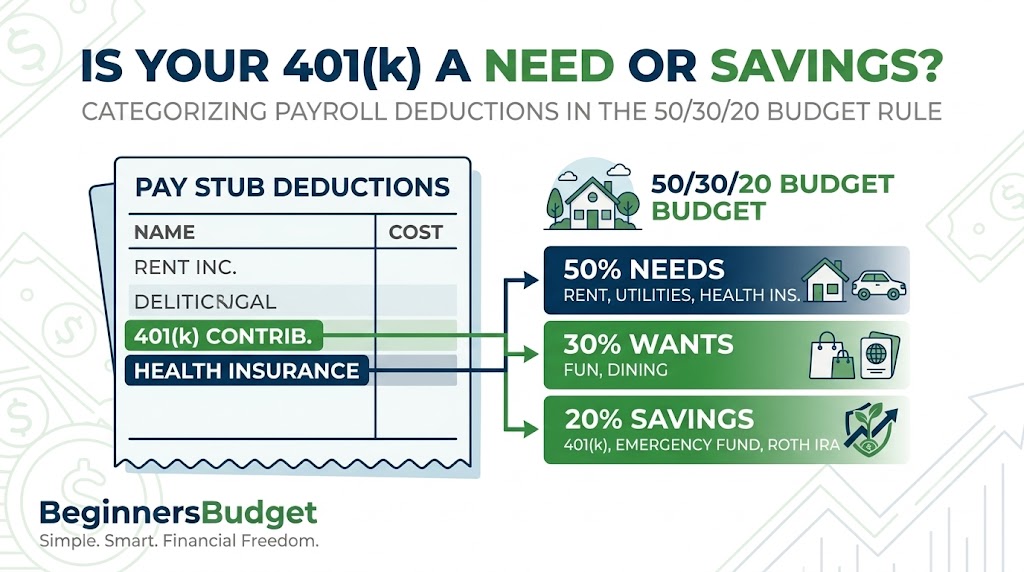
To keep your budget accurate, a 401(k) contribution is strictly Savings. Even though your payroll system deducts the money automatically alongside essential items like taxes and medical coverage, building long-term wealth is the fundamental purpose of the 20% “Savings and Debt Repayment” bucket.
Calling a 401(k) a “Need” distorts the framework. Essential needs are basic survival obligations like rent, basic groceries, and utility bills. While saving for retirement is essential for your future, it remains an investment allocation.
Where Do Other Payroll Deductions Belong?
Not everything pulled from your paycheck belongs in the savings category. Payroll deductions generally fall into three distinct buckets:
- Taxes (FICA, Federal, State, Local): Excluded entirely. Your budget only tracks money available after mandatory government taxes are removed.
- Health, Dental, & Vision Insurance: Categorized under Needs. Health coverage is a mandatory living expense required to protect your health and finances.
- 401(k), 403(b), & HSA/FSA Contributions: Categorized under Savings (or Needs in the case of medical HSAs used for current prescriptions).
Two Ways to Calculate Your 50/30/20 Budget with Payroll Deductions
To make the 50/30/20 budgeting rule work seamlessly with automatic paycheck deductions, you can choose between two methods depending on how granular you like to be.
Method 1: The “Real Take-Home” Method (Recommended)
The most accurate way to run a 50 30 20 budget breakdown with pre-tax retirement contributions is to “add back” your voluntary payroll deductions to your net take-home pay. This creates an Adjusted Net Income.
Step-by-Step Calculation:
- Start with your net bank deposit (Take-Home Pay).
- Add back your pre-tax 401(k) or 403(b) payroll deduction.
- Add back any voluntary savings or HSA contributions.
- Do NOT add back taxes or health insurance premiums.
The resulting number is your Adjusted Net Income, which you then split into 50%, 30%, and 20%.
Real-World Example:
- Let’s say your monthly pay stub shows:
- Net Checking Account Deposit: $3,600
- Pre-Tax 401(k) Contribution: $400
- Adjusted Net Income: $3,600 + $400 = $4,000
- Now calculate your buckets based on $4,000:
- 50/30/20 Allocation ($4,000 Adjusted Net Income):
├ngs (20%): $800 ($400 in 401(k) + $400 in Roth IRA/HYSA)
Because your employer already sent $400 directly to your 401(k), you only need to transfer an additional $400 from your bank account into savings or extra debt payoff to hit your full 20% goal!
Method 2: The Simple Net Method (The Quick Shortcut)
If you prefer a hands-off beginner budgeting method and want to avoid looking at pay stub line items every month, you can use the Simple Net Method. Under this shortcut, you completely ignore your pre-tax 401(k) contributions and budget strictly off the net cash that hits your checking account.
50% Needs: Half of your net checking account deposit.
30% Wants: Less than or equal to 30% of your net deposit.
20% Additional Savings: 20% of your net deposit sent to an IRA, emergency fund, or extra debt payment.
The Trade-Off: This shortcut means you are actually saving more than 20% of your true earnings, which is great for long-term wealth! However, it artificially shrinks your available “Wants” and “Needs” spending buckets, making your day-to-day budget feel tighter than it actually is.
Comparison: Method 1 vs. Method 2
To see how these two calculation methods impact your monthly spending power, look at how the math breaks down for someone earning $5,000 gross per month with a $500 monthly 401(k) payroll deduction:
| Budget Category | Method 1: Adjusted Net ($4,000 Base) | Method 2: Simple Net ($3,500 Base) | Practical Difference |
| Gross Salary | $5,000 | $5,000 | Same starting earnings |
| 401(k) Deduction | $500 (Tracked in Savings) | $500 (Ignored in budget) | Method 1 counts payroll savings |
| Needs Bucket (50%) | $2,000 | $1,750 | Method 1 gives +$250 for fixed bills |
| Wants Bucket (30%) | $1,200 | $1,050 | Method 1 gives +$150 for fun/lifestyle |
| Direct Bank Savings | $300 ($500 401k + $300 = $800) | $700 (In addition to 401k) | Method 2 forces double-saving ($1,200 total) |
What About Employer Matching Contributions?
A frequent follow-up question for beginners learning how to calculate 50 30 20 budget targets is whether to count an employer 401(k) match toward the 20% savings goal. If your employer matches 4% of your salary, does that count toward your 20%?
The Consensus: Treat employer matches as a bonus, not a replacement for your own 20% goal. While an employer match accelerates your retirement growth, the 50/30/20 framework is designed to build financial discipline with your own cash flow. Base your 20% calculation entirely on your personal contributions. If your employer adds extra money on top, view it as a welcome boost toward reaching financial independence sooner.
Final Thoughts
Understanding needs vs wants budgeting gets much easier once you know how to handle pre-tax line items. Your 401(k) is unquestionably Savings, even if it never reaches your checking account. By using the Adjusted Net Income method, you properly recognize the money you are already investing for your future self, giving you an accurate, guilt-free picture of what you can safely spend on housing, bills, and fun today.