The 50/30/20 Rule in High-Cost-of-Living Cities: How to Adjust the Math
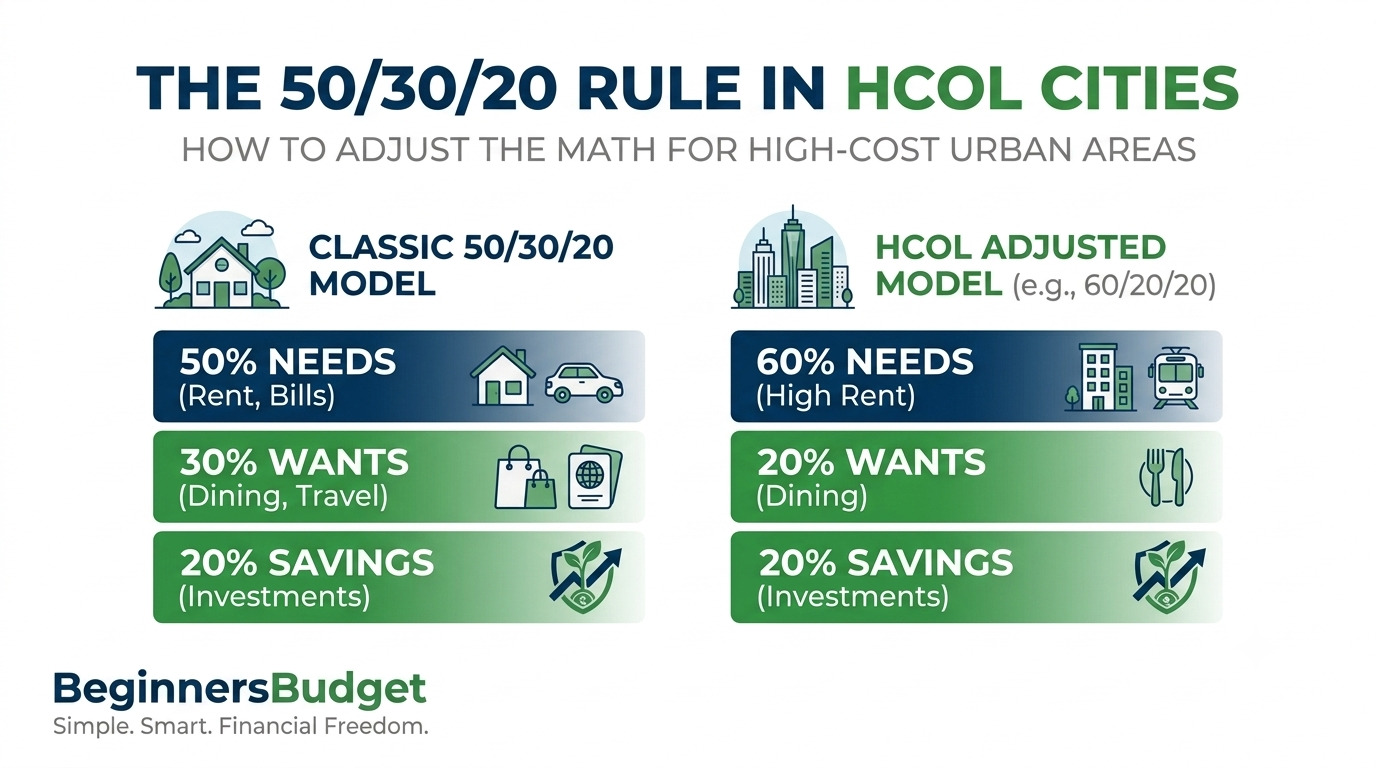
Popularized by Senator Elizabeth Warren in her book All Your Worth: The Ultimate Lifetime Money Plan, the 50/30/20 budgeting rule has long been touted as the gold standard for personal finance. The core framework is straightforward:
50% for Needs: Fixed costs like housing, utilities, groceries, healthcare, minimum debt payments, and basic transportation.
30% for Wants: Discretionary spending including dining out, entertainment, travel, subscriptions, and hobbies.
20% for Savings & Debt: High-interest debt payoff, emergency funds, 401(k) contributions, IRAs, and long-term investments.
While this framework works smoothly in mid-to-low-cost housing markets. Modern realities in major US metro areas such as New York City, San Francisco, Boston, Seattle, San Diego, and Los Angeles render the standard ratio nearly impossible for many residents. When average monthly rents for a one-bedroom apartment cross $2,500 to $3,500, allocating only 50% of take-home pay to all essential needs is mathematically unfeasible unless your net income is well into six figures. Instead of abandoning structured budgeting altogether, urban professionals can adjust the ratios to fit High-Cost-of-Living (HCOL) housing markets while keeping financial health intact.
Why the Traditional Math Breaks Down in HCOL Markets
To understand why the classic 50/30/20 model buckles in major cities, consider a single professional earning $90,000 annually in New York City or San Francisco:
Gross Income: $90,000 / year ($7,500 / month)
Estimated Take-Home Pay (after taxes & health insurance): ~$5,200 / month
50% Needs Cap: $2,600 / month
In cities where median single-bedroom rents routinely absorb $2,800 to $3,200 per month, housing alone exceeds the entire 50% “Needs” bucket before factoring in utilities, transit, groceries, and insurance. Strictly adhering to 50/30/20 under these conditions creates unnecessary stress. It forcing earners to feel like they are “failing” at budgeting when they are simply facing structural market pressures.
Modifying the Ratios: 3 Real-World HCOL Models
To maintain financial discipline in high-rent environments, financial planners recommend re-allocating the standard percentages based on your financial goals and life stage.
1. The 60/20/20 Model (The Savings-Protection Framework)
60% Needs | 20% Wants | 20% Savings
Its best for Career-focused professionals committed to long-term wealth building, retirement planning, or saving for a down payment despite high urban housing costs. The 60/20/20 model acknowledges that essential expenses will swallow a larger portion of income, but it treats the 20% savings target as non-negotiable. To absorb the extra 10% needed for rent and essentials, you reduce discretionary spending (“Wants”) from 30% down to 20%.
How it works in practice: If your take-home pay is $5,000, you designate $3,000 for needs, restrict wants to $1,000, and preserve $1,000 for savings and debt reduction.
2. The 55/25/20 Model (The Moderate Compromise)
55% Needs | 25% Wants | 20% Savings
Its best for Mid-career earners who have lowered their fixed costs slightly (e.g., sharing an apartment with roommates or living slightly further from city centers). This model serves as a middle ground. By increasing the needs category by only 5 percentage points, you maintain a healthy 25% allocation for discretionary spending allowing room to enjoy the lifestyle, culture, and social perks that make living in an HCOL city worthwhile.
3. The 65/20/15 Model (The High-Rent Survival Framework)
65% Needs | 20% Wants | 15% Savings
Its best for Entry-level professionals, graduate students, or residents living in extreme rent markets (e.g., Manhattan, San Francisco proper) where living solo is non-negotiable. When housing costs absorb up to 40%–45% of your net income, total needs may reach 65%. To avoid cutting lifestyle spending to an unsustainable degree, this framework temporary reduces savings contributions from 20% to 15%. While saving 15% is lower than the traditional target, it matches the general baseline recommendation from major financial institutions (like Fidelity) for long-term retirement planning.
Budget Model Comparison: $6,000 Monthly Take-Home Pay
To see how these adjustments play out in practice, consider a monthly net income of $6,000 ($100,000+ gross salary depending on local state and city tax rates):
| Budget Model | Needs Allocation | Wants Allocation | Savings Allocation | Strategic Focus |
| Traditional (50/30/20) | $3,000 (50%) | $1,800 (30%) | $1,200 (20%) | Low/Mid-cost markets |
| Savings-First (60/20/20) | $3,600 (60%) | $1,200 (20%) | $1,200 (20%) | Maximizing long-term wealth |
| Moderate (55/25/20) | $3,300 (55%) | $1,500 (25%) | $1,200 (20%) | Balanced urban lifestyle |
| Survival (65/20/15) | $3,900 (65%) | $1,200 (20%) | $900 (15%) | Extreme high-rent markets |
Strategic Levers to Make HCOL Budgeting Work
Beyond adjusting percentages on paper, navigating high-cost markets requires leveraging specific urban advantages to offset housing costs:
1. Factor the “Public Transit Offset” into Needs
In car-dependent suburban markets, transportation expenses (car payment, auto insurance, gas, maintenance) routinely cost $700–$1,000/month per vehicle. In transit-rich cities like NYC, DC, or Boston, relying on public transportation caps transit costs around $130–$150/month. That saved $600+ effectively supplements your housing budget, making a 60% Needs allocation far less restrictive than it appears on paper.
2. Treat “Needs” vs. “Wants” with HCOL Nuance
In high-density cities, traditional boundaries between needs and wants can blur:
Groceries vs. Dining Out: If cramped kitchen quarters make cooking every meal impractical, treat basic meal prep as a Need, but strictly categorize restaurant dining, drinks, and delivery fees under Wants.
Fitness: High-end boutique fitness memberships ($250+/month) belong in Wants, whereas basic low-cost gym passes or outdoor activities fit into baseline health needs.
3. Cap Housing at 30%–35% of Gross Income
While the 50/30/20 rule uses take-home (net) pay, traditional landlord qualification standards rely on gross income (the “40x monthly rent” rule in NYC or the 30% gross income rule elsewhere). Ensuring your rent does not exceed 35% of your gross pay keeps your net-income budgeting ratios from collapsing into 70%+ needs allocations.
Final Thoughts: Adapt the Framework to Your Reality
The 50/30/20 rule was created as a flexible guiding principle, not an unyielding law. Living in a high-cost city often comes with trade-offs—higher earning potential, career density, cultural access, and walkable infrastructure at the expense of elevated real estate costs.
By consciously shifting your ratio to 60/20/20 or 55/25/20, you can accommodate local rent realities while protecting the single most vital component of financial security that is consistent long-term saving.